Turn your observations into calibrated measurements.
Upload your observations, choose your target and output, and let the pipeline handle plate solving, aperture photometry, calibration, and light-curve generation.
Upload observations
FITS files only
Please upload FITS images only — not PNG, JPG, or other display-image formats. FITS files can be downloaded or exported from your smart-telescope app.
Expected photometric bands and precision: individual vs. stacked FITS images
Individual exposures are measured directly from the native Bayer data and currently return calibrated B, V, and R measurements. Native stacked images are handled differently and, in the current version of the tool, return V-band photometry only.
Based on our current validation tests, V-band measurements from individual exposures typically achieve a few-percent precision under good observing conditions, while B and R measurements currently show larger scatter and should generally be treated as approximately 10–15% precision. These values are practical performance estimates rather than guaranteed uncertainties and can vary with target brightness, saturation, crowding, image quality, and observing conditions.
Drop FITS files here
or click to browse your computer
.fit · .fits · .ftsSee what the pipeline produces.
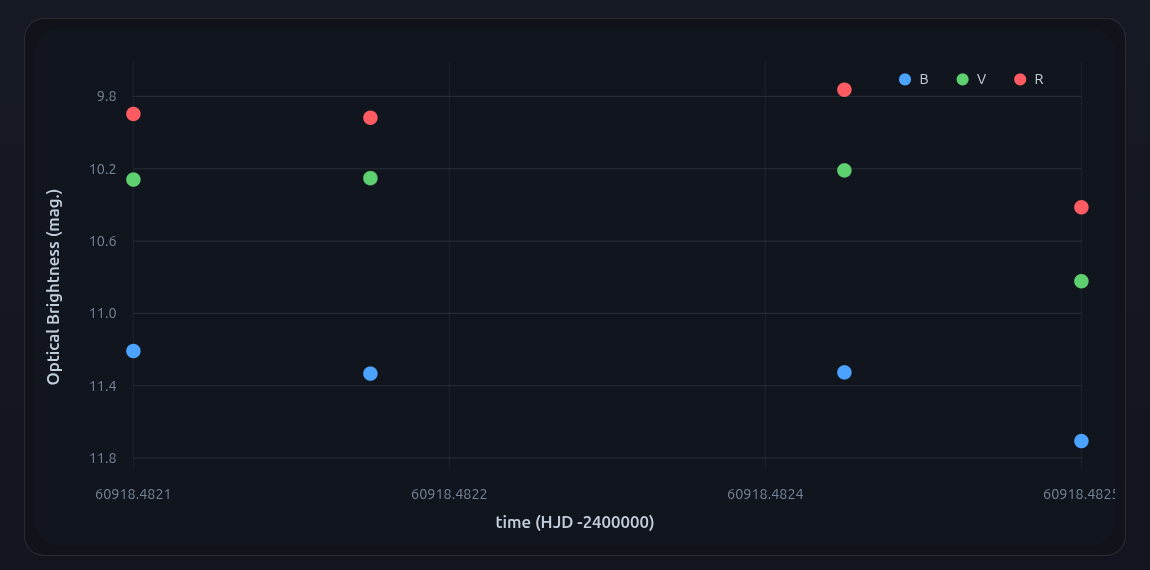
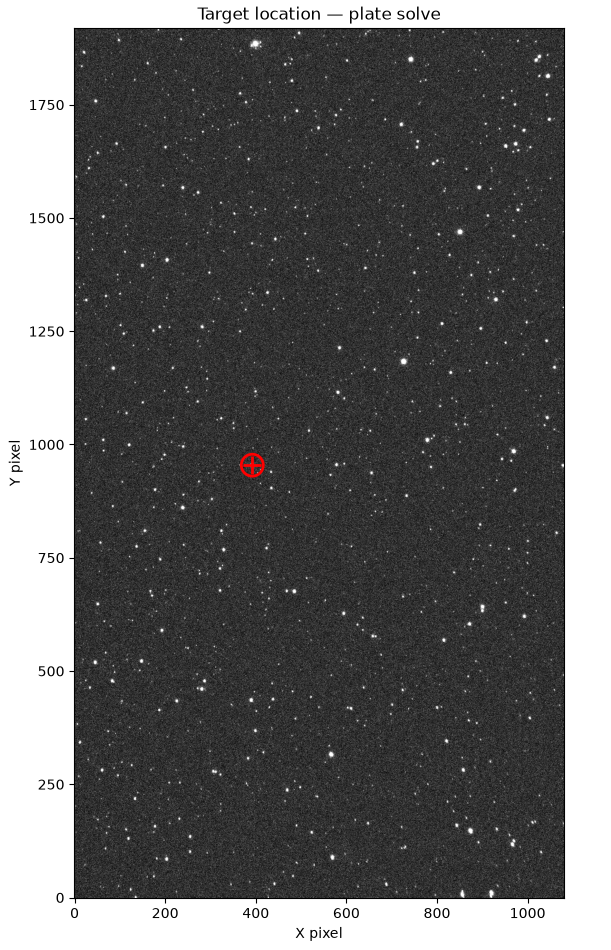
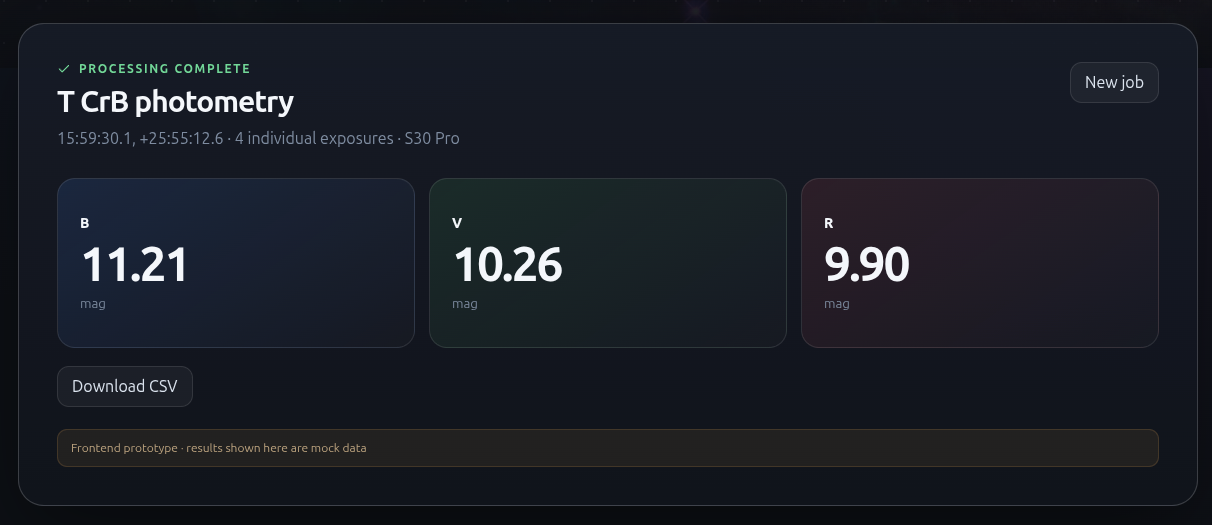
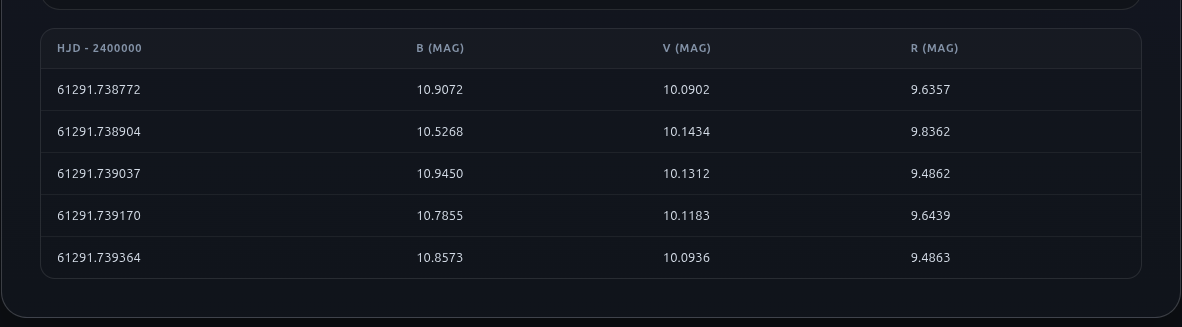
Examples from the current development workflow: a multi-band light curve, target identification after plate solving, and a calibrated single-measurement result.
Choose an exposure that keeps the target unsaturated.
These guidelines are based on our current Seestar validation tests and are intended as practical starting points. Actual saturation limits can vary with observing conditions, focus, target color, and image stacking.
| Approx. target magnitude | Recommended exposure guidance |
|---|---|
| 6 mag | Stars this bright tend to saturate even in 2-second exposures. Reliable photometry may not be possible with the current setup. |
| 7 mag | Stars also tend to saturate even at 2 seconds. Reliable photometry may not be possible with the current setup. |
| 8 mag | Use individual 2-second exposures. Stars tend to saturate at 5 seconds or longer, so stacked images should be avoided. |
| 9 mag | Individual 2- and 5-second exposures are generally safe. At 10 seconds the target approaches saturation, so avoid stacked images when possible. |
| 10 mag | Individual exposures of 2, 5, and 10 seconds are generally usable. Ten-second exposures remain unsaturated in our tests. Avoid stacked images when possible. |
| 11 mag | Individual 5- and 10-second exposures work well. The target is still detected at 2 seconds, although only weakly (about 3,000 ADU peak in our tests). Stacks with a small number of frames should generally be usable. |
| 12 mag | Use 5- or 10-second exposures. The target is typically not detected well at 2 seconds and reaches only about 3,000 ADU peak at 5-10 seconds. In our tests, a roughly 1-minute stack remained usable, while a roughly 2-minute total stack saturated. |
A scientific workflow hidden behind a simple upload.
The pipeline identifies the image format, plate solves when needed, measures the target and comparison stars, calibrates the photometry, and prepares the requested output.
Learn morePlate solving
Existing WCS is used when available; otherwise the image is solved automatically.
Aperture photometry
Instrument-specific apertures measure the target and suitable comparison stars.
Calibrated output
The pipeline returns calibrated magnitudes, tables, and HJD light curves.